
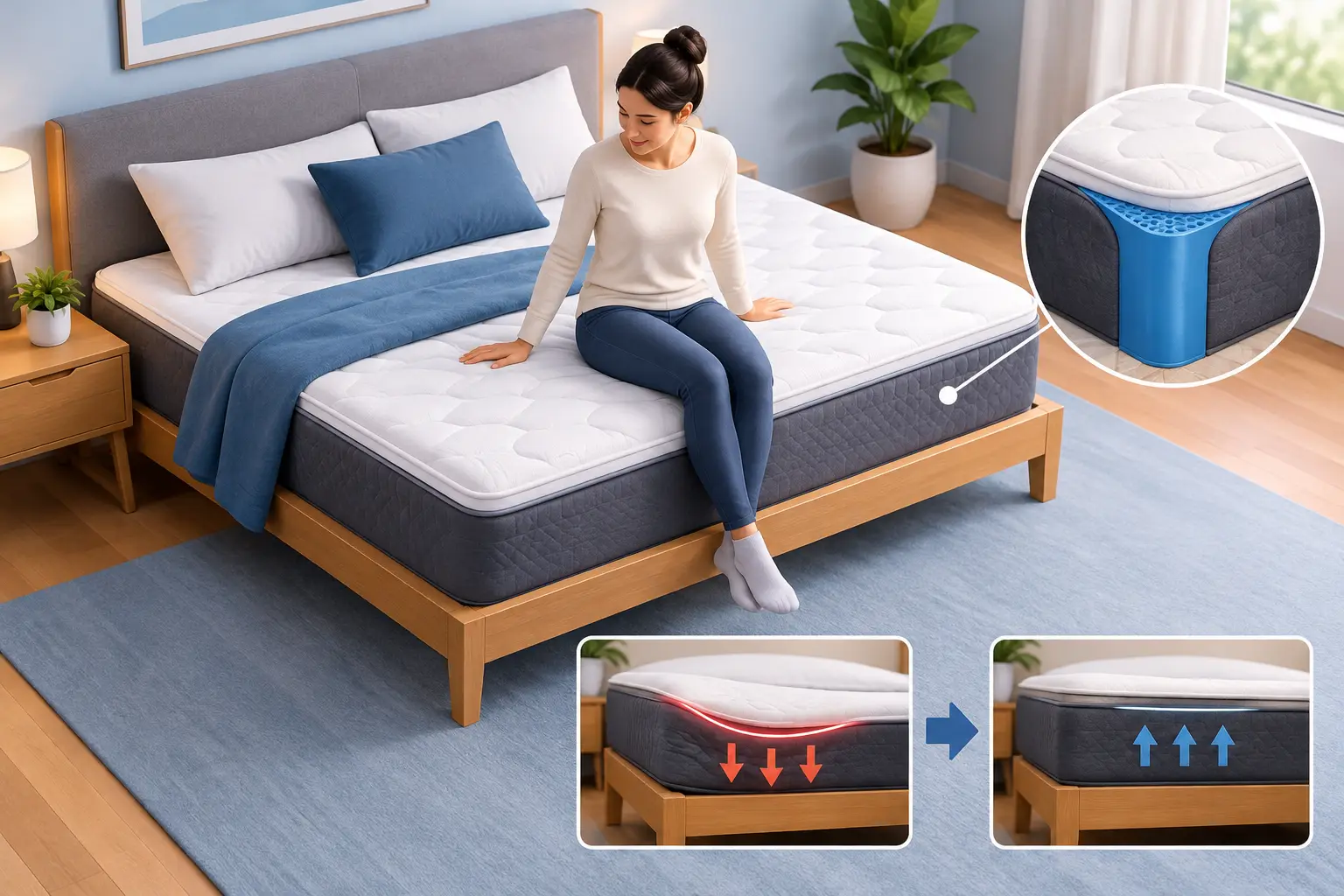
The edge of a mattress does more work than most people realize. It supports you when you sit to put on shoes, helps you get in and out of bed, and often carries more weight on the same few inches night after night. To prevent mattress edge sagging, start by treating the mattress, bed base, and daily use habits as one support system rather than separate purchases.
A softened edge is not always a sign that the entire mattress has failed. Some upholstery layers naturally relax with use, especially on plush comfort models. But a pronounced dip, a leaning edge, or a feeling that you may slide off the bed points to a support issue worth addressing early.
The bed base is the first place to check when mattress edges begin to feel weak. A quality mattress cannot perform as intended when it sits on bowed slats, a damaged box foundation, or a frame without adequate center support.
For a slatted bed, the slats should be strong, evenly spaced, and securely held in place. Wider gaps can allow foam and spring systems to push downward between slats, creating uneven stress along the perimeter. A solid platform can work well for many foam, latex, and hybrid mattresses, provided it is flat, dry, and properly ventilated.
Larger mattress sizes need center support that reaches the floor. Without it, the frame can flex in the middle and pull the outer sides downward over time. Check the legs and crossbars periodically, particularly after moving the bed or rearranging a room. A loose bolt can create a problem that looks like mattress sagging but is actually caused by the frame.
The correct foundation also depends on the mattress construction. Pocket spring and Bonnell spring mattresses generally need even, stable support to keep their spring units aligned. Foam, visco memory foam, gel memory foam, and latex mattresses need a level surface that prevents localized compression. If you are unsure whether your current base is suitable, review the mattress care guidance before making changes. The wrong foundation can affect comfort, durability, and warranty coverage.
Rotation is one of the most practical ways to prevent mattress edge sagging. It changes which areas carry your body weight and reduces repeated pressure on the same entry and exit side of the bed.
For most modern one-sided mattresses, rotate the mattress 180 degrees so the head becomes the foot. Many households benefit from doing this every three to six months. A heavier mattress, a couple sharing a bed, or a person who consistently sleeps near one edge may require more frequent rotation. Mark a reminder on your calendar so it becomes part of regular home care rather than a task remembered only after a dip appears.
Do not flip a one-sided mattress unless its label specifically states that it is double-sided. Flipping a no-flip design places the support core on top and the comfort layers underneath, which can make the bed uncomfortable and may damage it. Double-sided mattresses have different care requirements, so follow their specific instructions.
When rotating, inspect the mattress surface and the base underneath. Look for uneven slats, broken springs in the foundation, moisture, or a visible indentation. Catching these issues early is far easier than trying to correct a deep sag later.
Mattress edges are designed to support normal sitting and sleeping, but they are not intended to function as a bench. Repeatedly sitting in the exact same spot for long periods concentrates force on the perimeter and can compress both the comfort layers and edge support system.
This does not mean you should avoid the edge completely. Sitting briefly to get dressed, help a child, or enter and leave the bed is normal. The goal is simply to vary the spot when possible and avoid using the mattress edge as a daily workstation, storage surface, or place for children to jump.
Jumping and rough play can be particularly hard on spring units and foam rails. The damage may not be visible immediately, but internal components can shift or weaken over time. If children use the bedroom as a play space, setting this expectation protects both the mattress and the bed frame.
Body weight distribution matters as well. Couples can reduce uneven wear by rotating regularly and ensuring the mattress is the right size and support level for both sleepers. A mattress that feels too soft for the people using it may allow excessive compression throughout the surface, including the edges.
A mattress protector cannot reinforce a weak edge, but it can help preserve the materials that support it. Sweat, spills, humidity, and body oils can gradually affect foam, fibers, and fabric. Moisture also raises the risk of odors and mold in poorly ventilated conditions.
Choose a fitted protector that lies smoothly across the mattress without pulling tightly on the corners. It should protect against spills while allowing airflow. A protector that traps excessive heat or moisture may make the mattress feel less comfortable, particularly with foam and memory foam constructions.
If a spill reaches the mattress, address it promptly. Blot rather than soak the area, use only the cleaning method recommended for the mattress, and allow it to dry completely before remaking the bed. Never cover a damp mattress with sheets and a protector, as trapped moisture can affect both hygiene and material performance.
The best time to prevent edge sagging is before the mattress reaches your bedroom. Not every mattress is built with the same perimeter reinforcement, and the right option depends on how you use the bed.
If you often sit on the side of the bed, share a mattress, have limited mobility, or prefer the full usable width of the sleep surface, ask specifically about edge support. Innerspring and pocket spring models may use reinforced coils around the perimeter. Foam and hybrid mattresses may use denser foam rails or a strengthened support core. Each approach can feel different, so test the edge by sitting on it briefly and lying near it in the showroom.
A firmer edge does involve a trade-off. Some sleepers prefer a softer, more cushioned feel all the way to the sides, especially on plush mattresses. Others value the stability of a reinforced perimeter. The right choice is not simply the firmest edge. It is the construction that supports your comfort preference, sleeping position, and daily routine.
A mattress consultant can help compare construction types without making the process complicated. Explain whether you sit on the bed frequently, sleep close to the edge, or need a stable surface for getting up. Those details are often more useful than choosing by firmness alone.
Minor settling in the comfort layers can be normal, especially during the first period of use. A true sag is more concerning when it remains visible without anyone on the mattress, affects sleep comfort, or makes the edge feel unstable.
Before assuming the mattress is at fault, place it on a confirmed flat, supportive surface and inspect the frame. Then remove thick bedding and look across the surface in good light. If there is a substantial, persistent indentation, take clear photos and review the warranty terms and care requirements. Keeping proof of purchase and using an appropriate base can make this process more straightforward.
Do not try to repair a sag by placing boards, folded blankets, or cushions under one side of the mattress. These temporary fixes create uneven pressure and can worsen the issue. They also do not solve a damaged frame, worn support core, or unsuitable foundation.
A mattress should make the edge of the bed feel dependable, not like a place you need to avoid. With a stable base, regular rotation, sensible daily use, and a construction matched to your needs, you can protect that support and enjoy more of the mattress surface for years to come.
