
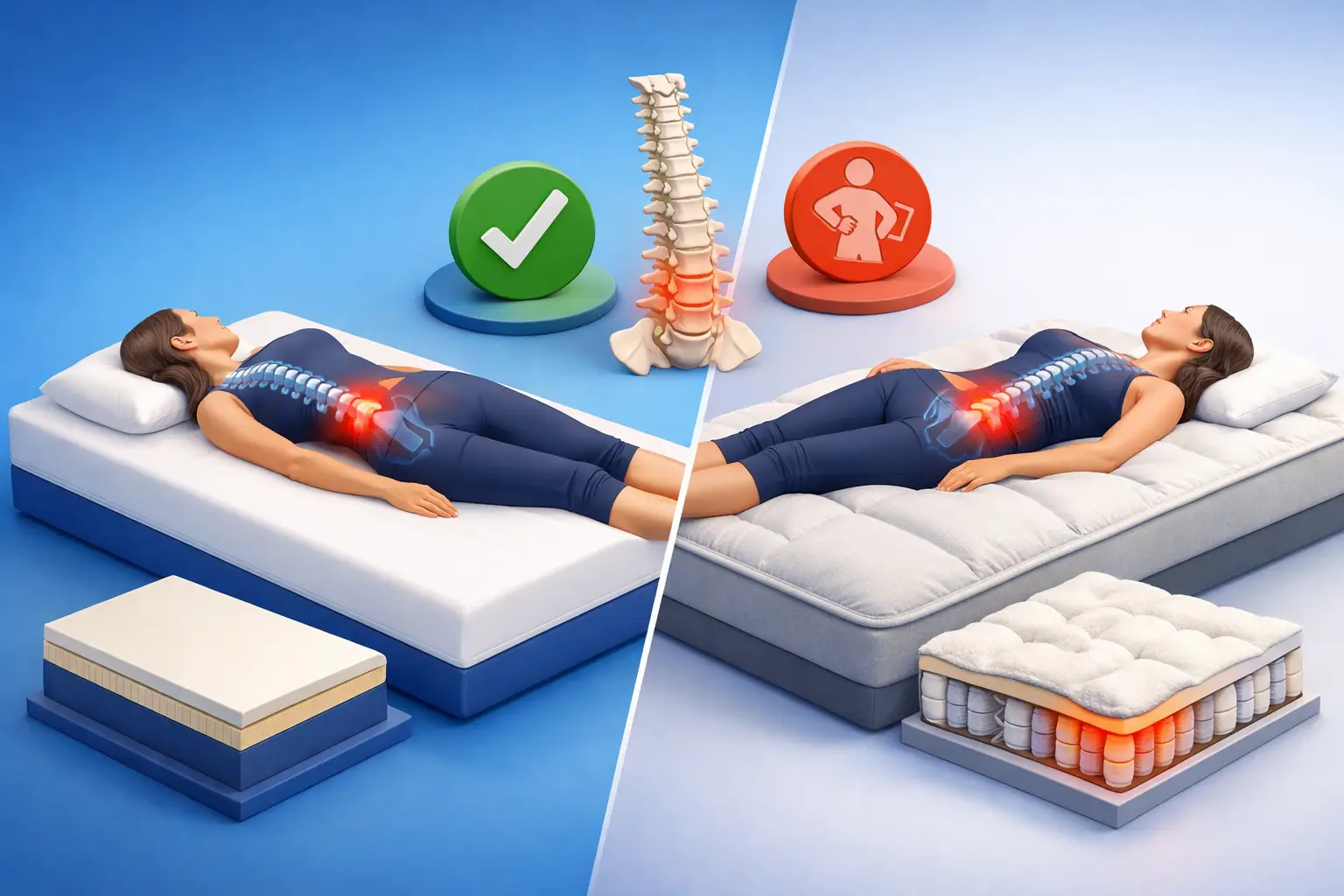
Back pain can make a normal night’s sleep feel like work. If you wake up stiff, sore through the lower back, or uncomfortable when changing positions, it is reasonable to ask: is a firm mattress better for back pain? The short answer is sometimes, but not always. The right mattress is usually the one that keeps your spine supported and your pressure points cushioned at the same time.
That balance matters more than firmness alone. Many people assume harder means healthier, yet a mattress that feels too firm can create its own problems. Others do better on a firmer surface because it prevents the hips from sinking too deeply. What helps your back depends on your body type, sleep position, and the type of mattress construction under the cover.
No. A firm mattress can be helpful for some sleepers with back pain, but it is not a universal fix. Back support is not just about surface feel. It is about whether the mattress keeps the spine in a more neutral line while still allowing the shoulders, hips, and knees to settle comfortably.
If a mattress is too soft, the pelvis may dip lower than the rest of the body. That can place extra stress on the lower back, especially for back and stomach sleepers. In that case, moving to a firmer model often helps because the body stays more level.
But if a mattress is too firm, the body may rest on top of the surface without enough contouring. Side sleepers often notice this first. Their shoulders and hips take the pressure, and the spine can end up pushed out of alignment. That can lead to soreness in the lower back, upper back, or even the neck.
So the better question is not simply whether firm is better. It is whether the mattress is supportive enough for your frame and sleep style.
A mattress that supports a healthier sleep posture typically does three things well. First, it holds up the heavier parts of the body, especially the hips and midsection. Second, it relieves pressure where the body naturally presses more deeply into the bed. Third, it stays consistent across the night, rather than feeling supportive for a few minutes and then sagging under load.
This is why firmness ratings can be misleading on their own. Two mattresses may both be called firm, but one could be a dense foam design that feels flat and unyielding, while another might use a responsive spring system with a comfort layer that cushions just enough. One may suit your back very well. The other may not.
For many adults, medium-firm tends to be the safest starting point for back comfort because it combines support with some contouring. That said, heavier sleepers often need a firmer build to avoid sinking too far. Lighter sleepers may need slightly more pressure relief to avoid feeling pushed up by the mattress.
Your main sleep position has a direct effect on whether a firmer mattress is likely to help.
Back sleepers often do well on medium-firm to firm mattresses because the surface can support the natural curve of the spine without letting the hips drop too much. If you sleep mostly on your back and your current mattress feels soft or hammock-like, a firmer option may improve morning stiffness.
Side sleepers usually need more cushioning at the shoulders and hips. A mattress that is too firm can create pressure buildup and twist spinal alignment. For this group, medium or medium-firm often works better than very firm. Support still matters, but so does contouring.
Stomach sleeping tends to place more strain on the lower back. A firmer mattress can help reduce that by keeping the pelvis from sinking too deeply. If you sleep on your stomach most of the night, a firmer feel is often the better direction.
If you change positions often, look for balanced support with easy movement. In these cases, the question is less “is a firm mattress better for back” and more whether the mattress adapts well without trapping you in one posture.
Construction has a major impact on how support feels.
Pocket spring mattresses often offer targeted support and better response because each spring can move more independently. This can be useful for people who want support with a less rigid feel.
Bonnell spring mattresses generally feel more traditional and can provide a stable surface, though the comfort experience depends on the layers above the spring unit.
Foam mattresses can work well for back pain when the foam density and layer design are right. Lower-quality foam may soften too quickly and lose support, while better-built foam models can provide steady pressure relief and body alignment.
Memory foam and gel-infused memory foam are often chosen for contouring. They can help reduce pressure points, but the best result depends on whether the core support keeps the spine level. Too much sink can be an issue for some sleepers, especially if the mattress is not designed with enough underlying support.
Latex tends to feel supportive, resilient, and less sink-in than traditional memory foam. For sleepers who want pressure relief without a deeply hugging feel, it can be a strong option.
Medical or orthopedic-style mattresses are designed to prioritize support, but even here, comfort layers matter. A mattress marketed for back support still has to match the person sleeping on it.
The body usually gives clear signals.
If your mattress is too soft, you may notice lower back pain in the morning, a feeling of sagging near the hips, or difficulty turning because the surface feels unsupportive.
If your mattress is too firm, you may wake with pressure at the shoulders or hips, numbness in the arms, or a sense that your back feels tight rather than supported. Side sleepers often describe this as feeling like they are fighting the bed instead of settling into it.
Pain that improves after you get up and move around can be a clue that your sleep surface is contributing to the problem. Pain that stays the same throughout the day may have other causes, and that is worth discussing with a healthcare professional.
Start with your primary sleep position, then consider body weight and mattress material. This gives you a more reliable starting point than shopping by firmness label alone.
If you are a back sleeper of average build, medium-firm is often a practical place to begin. If you are heavier or sleep on your stomach, firm may offer better support. If you are lighter or sleep on your side, medium or medium-firm usually provides a better balance.
Pay attention to how the mattress supports the lumbar area. You should not feel a large gap under the lower back when lying on your back, but you also should not feel your hips dropping below the rest of your body.
It also helps to assess durability. A mattress that feels supportive in the showroom but loses shape quickly will not keep your back comfortable for long. This is where guided selection matters. A good mattress consultant will ask about your sleep position, body type, comfort preference, and any pain points before narrowing the options.
For households buying across different needs, such as a master bedroom, guest room, or furnished property, this matters even more. The best mattress on paper is still the wrong one if it does not match the sleeper using it.
A firmer mattress is often a good fit if you sleep on your back or stomach, carry more body weight, or feel unsupported on softer beds. It can also help if your current mattress shows signs of sagging or if you regularly wake with lower back discomfort that improves on more supportive surfaces.
What you want is firm support with enough comfort on top, not a hard sleeping surface for its own sake. Those are not the same thing.
If you are a side sleeper, have prominent pressure points, or feel joint discomfort on harder surfaces, going too firm may make sleep worse. The same applies if you prefer a mattress that contours more closely and your current issue is pressure, not sagging.
This is why the best outcome usually comes from matching firmness to your body rather than chasing the firmest model available. At Towell Mattress ME, that matching process is exactly where expert guidance makes a real difference.
The right mattress should let your back rest, not brace. If you focus on support, alignment, and construction instead of firmness alone, you are far more likely to wake up comfortable and stay that way.
