
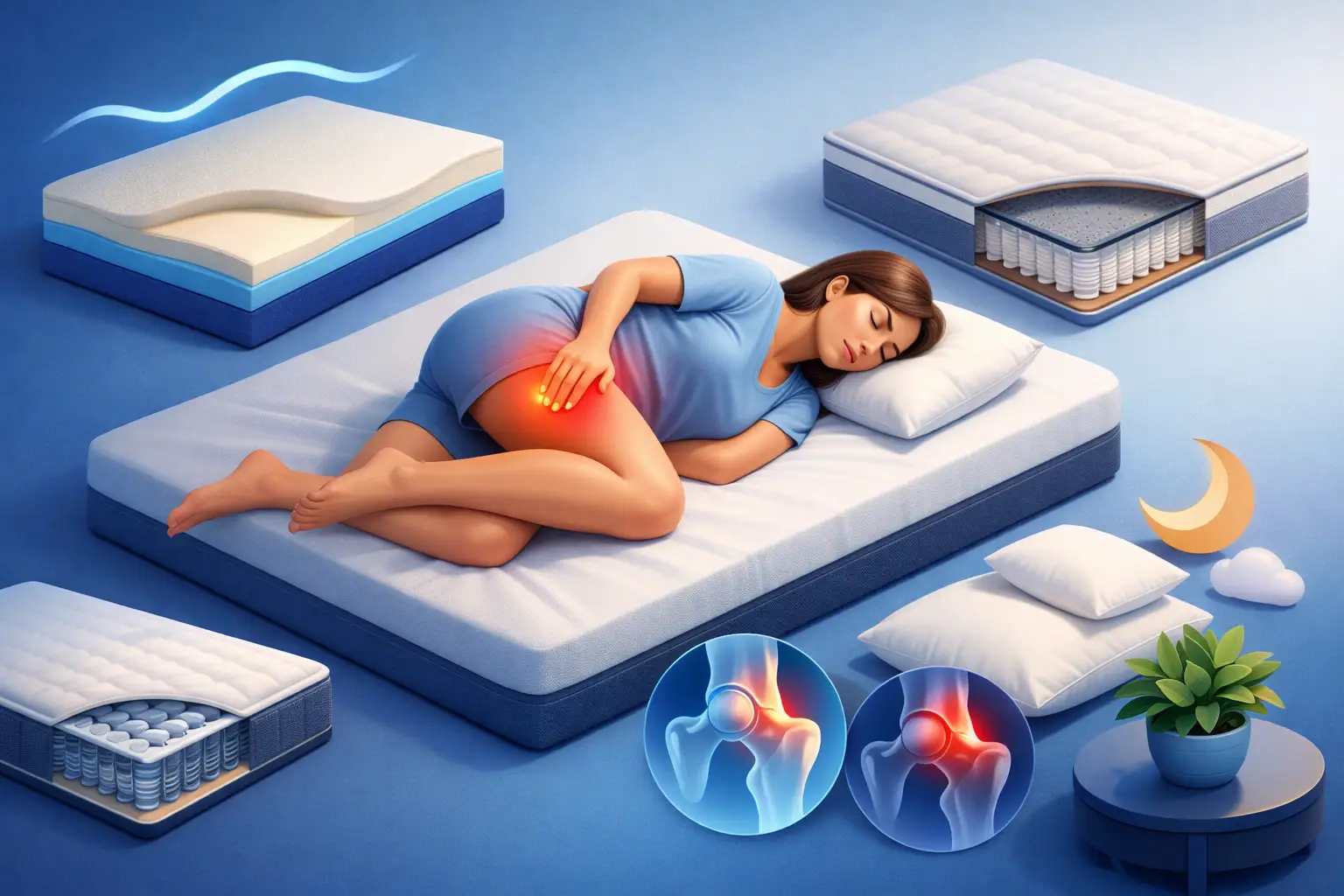
If your hip starts complaining before your alarm goes off, your mattress may be part of the problem. Many shoppers ask what mattress is best for hip pain, but the better question is usually this: what kind of support keeps your hips aligned without creating extra pressure where you already hurt?
Hip pain at night usually comes from one of two issues. The mattress is either too firm and pushes back at the joint, or too soft and lets the pelvis sink out of alignment. Both can leave you waking up sore, stiff, or shifting positions all night. The right mattress sits in the middle – supportive enough to hold your body level, with enough cushioning to reduce pressure around the hips.
For most adults, a medium to medium-firm mattress is the safest starting point. That comfort range tends to give the hips enough pressure relief without letting the lower back and pelvis dip too far. It works well because hip pain is rarely solved by softness alone. You need contouring, but you also need structure underneath it.
That is why mattresses built with pressure-relieving comfort layers over a stable support core often perform best. Memory foam, gel-infused memory foam, latex, and well-designed pocket spring models can all be good options, depending on your body weight, sleep position, and how much cushioning you prefer.
A very firm mattress is not automatically better for joint pain. Some people assume more firmness means more support, but support and hardness are not the same thing. A mattress can be supportive while still allowing your shoulders and hips to settle just enough to keep the spine in a more neutral position.
Your hips carry a lot of load when you lie down, especially if you sleep on your side. On a mattress that is too firm, that weight concentrates at the hip instead of being distributed across the surface. The result can feel like a sharp pressure point or a dull ache that builds through the night.
On a mattress that is too soft, the issue changes. The pelvis sinks lower than the rest of the body, which can twist the spine and stress the lower back, hips, and surrounding muscles. You may not notice it immediately, but after several hours in one position, it often shows up as morning pain.
This is why mattress selection for hip pain is less about choosing the softest bed and more about choosing balanced support. The mattress should cushion the joint while keeping the body from collapsing into it.
Memory foam is one of the most common recommendations because it contours closely around the hips and helps reduce pressure. If your current mattress feels hard under the hip bone or outer thigh, memory foam can be a strong option. It suits many side sleepers and people who want a more cradled feel.
Gel-infused memory foam offers a similar pressure-relieving effect with a slightly cooler feel for those who are sensitive to heat retention. For many shoppers, that makes it easier to enjoy the contouring benefits of foam without feeling overly warm.
Latex can also work very well for hip pain, especially if you want pressure relief with a more responsive surface. Compared with traditional memory foam, latex tends to feel a little more buoyant and easier to move on. It cushions the hips without the deep sinking sensation some sleepers do not enjoy.
Pocket spring mattresses are another strong choice when designed with the right comfort layers. Individually wrapped coils can provide targeted support and reduce motion transfer, while the top layers handle pressure relief. For couples or shoppers who prefer a more traditional mattress feel, pocket springs often offer a good balance of comfort and structure.
Basic spring systems with thinner comfort layers may be less forgiving if hip pain is already a concern. They can still suit some back sleepers or value-focused buyers, but if pressure relief is the priority, it usually makes sense to look for more advanced cushioning above the support unit.
Your sleep position changes what your hips need from the mattress.
Side sleepers usually need the most pressure relief. The hip and shoulder press directly into the mattress, so a surface that is too firm can become uncomfortable quickly. A medium or medium-soft feel may work best if the support underneath is still strong enough to keep the waist and lower back from dropping.
Memory foam, gel memory foam, and softer latex comfort layers are often a good fit here. Pocket spring mattresses with pressure-relieving tops can also perform well.
Back sleepers usually do best on a medium to medium-firm mattress. The goal is to support the natural curve of the spine while allowing the hips to settle slightly without sinking too low. If the mattress is too plush, the pelvis may dip and pull the lower back out of alignment.
Back sleepers often do well on pocket spring, latex, and firmer foam models that combine cushioning with stronger core support.
Stomach sleeping can aggravate hip and lower back strain if the midsection sinks too much. Most stomach sleepers need a firmer feel than side sleepers, with enough support to keep the pelvis lifted. If hip pain is present, stomach sleeping itself may be part of the issue, so mattress comfort alone may not fully solve it.
Two people can lie on the same mattress and have very different results. Lighter sleepers may find a medium-firm mattress too hard because they do not sink in enough to reach the pressure-relieving layers. Heavier sleepers may find that same mattress too soft if it compresses too deeply under the hips.
As a general rule, lighter individuals often prefer a slightly softer surface for better pressure relief, while heavier individuals usually need a firmer support system to maintain alignment. This is where guided selection becomes valuable. The best mattress for hip pain is not only about material – it is about how that material responds to your body.
If you wake up with more pain than you had when you went to bed, that is a warning sign. So is pain that improves after you get up and move around. That pattern often points to pressure buildup or poor alignment during sleep.
You may also notice that you sleep better in some positions than others, or that one side of the mattress feels worse because it has softened over time. Sagging, body impressions, and uneven support are especially problematic when hip pain is involved. Even a good mattress will stop performing well if its support system is worn out.
When comparing options, focus on three things: pressure relief, spinal alignment, and durability. A mattress that feels comfortable for five minutes in a showroom can still be wrong if it does not support your hips consistently through the night.
Look closely at the comfort layers and the support core. Thick foam on top can feel pleasant at first, but without the right base support, it may allow the pelvis to sink too far. On the other hand, a strong support system without enough cushioning may leave the hip joint under too much direct pressure.
This is why balanced constructions often work best. For example, pressure-relieving foam or latex over pocket springs can give both contouring and stability. For shoppers who prefer all-foam designs, higher-quality memory foam or gel foam over a supportive base can also be effective.
If you are unsure where to begin, start with a medium feel and adjust from there based on your sleep position and build. That starting point works for the widest range of people dealing with hip discomfort.
The mattress does most of the work, but your overall sleep setup matters too. Side sleepers often benefit from placing a pillow between the knees to reduce hip rotation. Back sleepers may feel relief with a pillow under the knees. These small adjustments can reduce strain and help the mattress perform better.
It is also worth checking whether your current foundation or bed base is contributing to the problem. An uneven or unsupportive base can change how the mattress feels and performs, even if the mattress itself is well built.
Hip pain is personal. The right feel for one sleeper may be completely wrong for another, even within the same mattress category. That is why broad advice only goes so far. The most reliable choice comes from matching mattress type, comfort level, and support design to your body and sleep habits.
For shoppers who want reassurance before making a decision, working with a mattress consultant can remove much of the guesswork. A guided selection process helps narrow the field quickly and focus on models that support pressure relief, alignment, and long-term comfort.
If you are trying to solve hip pain, do not shop by firmness label alone. Shop for a mattress that keeps your body level, cushions the joint, and still feels supportive after more than a few minutes. That is usually where better mornings begin.
