
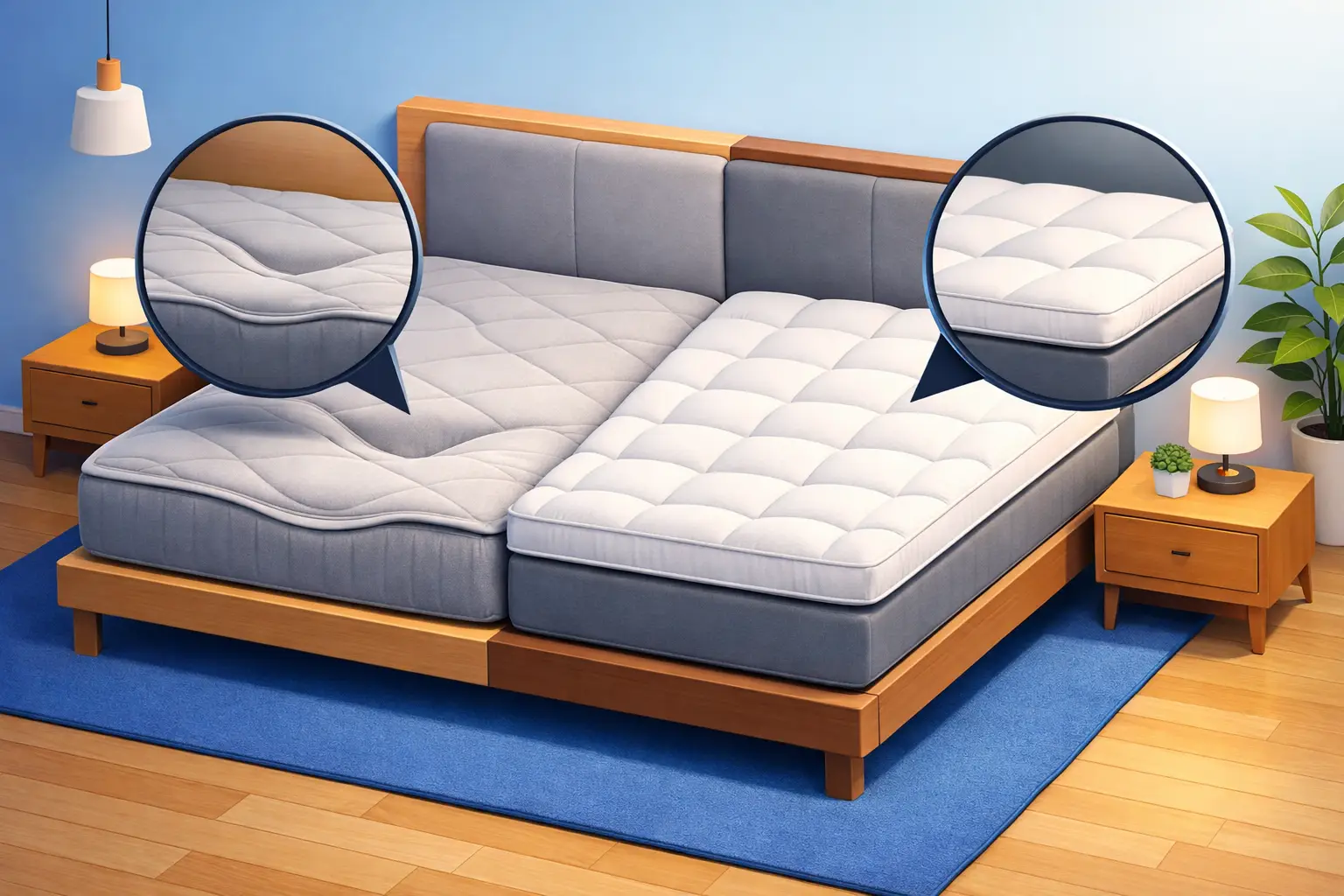
You usually notice a sagging bed before you can explain it. You wake up with pressure in your lower back, feel yourself rolling toward the middle, or realize your mattress no longer looks level. At that point, one question comes up quickly: do mattress toppers fix a sagging bed? Sometimes they help with surface comfort. But if the mattress structure underneath has failed, a topper is usually a temporary patch, not a true fix.
A mattress topper sits on top of the mattress and changes how the sleep surface feels. It can add softness, reduce pressure points, and in some cases make a mildly uneven bed feel more comfortable for a short time. What it cannot do is rebuild broken support.
That distinction matters. If your mattress has a slight body impression and still feels supportive overall, a topper may improve comfort enough to extend its usable life. If the sag is deep, concentrated in the center, or caused by worn springs, collapsed foam, or a weak foundation, the topper will simply follow the dip.
Think of it this way: a topper improves the finish, not the frame. If the mattress core is no longer holding your body in proper alignment, adding more material on top rarely corrects the problem.
There are situations where a topper is a practical short-term solution. The key is that the mattress must still have a reasonably stable support system underneath.
Over time, many mattresses develop light surface wear. Foams may soften slightly, quilting can compress, and the bed may feel less cushioned than it did when new. In these cases, a topper can restore comfort by adding a fresh layer between your body and the mattress.
This is most useful when the mattress feels too firm, slightly uneven, or less pressure-relieving, but you are not sinking excessively into one area.
A topper can also help if your comfort needs have changed. Side sleepers often want more pressure relief around the shoulders and hips. Some back sleepers need a touch more cushioning without losing support. If the mattress is still sound, a topper can fine-tune the feel instead of forcing a full mattress replacement too soon.
For a bed that is not used every night, a topper may be enough to improve comfort for occasional sleepers. The demands are lower than on a primary bedroom mattress, so a modest improvement may be worthwhile.
This is where many buyers lose time. If the real issue is support failure, a topper may make the bed feel plusher at first, then worse after a few nights.
If you can see a dip when the bed is empty, the problem is already beyond surface comfort. A topper will sink into the same low area. Instead of leveling the bed, it often exaggerates the feeling that you are sleeping in a hollow.
In spring mattresses, sagging can come from fatigued coils or uneven tension across the sleep surface. In foam mattresses, the comfort layers or core may have compressed beyond recovery. Once the internal support is compromised, the mattress is no longer distributing weight properly. No topper can replace that lost structure.
Sometimes the mattress gets blamed when the real problem is underneath it. Slats that are too far apart, a bowed platform, or an aging box spring can all create a sagging feel. If the support base is weak, adding a topper on top does nothing to solve the cause.
If you wake up with stiffness, lower back discomfort, or the feeling that your hips are dropping too low, your spine may not be staying in a neutral position overnight. A topper may add softness, but softness is not the same as support. In many cases, it makes alignment worse.
Before buying any sleep accessory, it helps to check whether the issue is cosmetic, comfort-related, or structural.
Start by removing all bedding and looking at the mattress from the side. If the surface appears visibly lower in the middle or where one person sleeps most often, that is a warning sign. Then press down with your hands across different sections. If one area feels much softer or less responsive, the materials may be breaking down.
Next, check the foundation. Make sure the frame is level, center support is intact, and slats are not bowed or spaced too widely. If possible, place the mattress temporarily on a flat, supportive surface and see whether the sagging feel improves. That test can quickly tell you whether the problem is the mattress, the base, or both.
If the mattress is several years old and has consistent impressions where sleepers lie, that points more toward wear than a simple comfort issue.
If your mattress has only mild wear and you want to improve comfort short term, choose carefully. A topper should match both the mattress condition and your sleep style.
Memory foam toppers can help with pressure relief and motion absorption, especially for side sleepers. Latex toppers tend to feel more responsive and can offer a steadier surface with less sink. Thicker is not always better. On a mattress that already sags, an overly thick topper may let heavier parts of the body sink deeper.
For a slightly firm mattress with light wear, a medium-feel topper can smooth out the surface. For a mattress that is already too soft, adding a plush topper is usually the wrong move. It may feel comfortable for a few minutes, then create more alignment problems overnight.
This is where guided selection matters. A sleep product should solve the actual problem, not just add another layer to it.
The right answer depends on the condition of the bed, not just the symptom.
If your mattress still supports you evenly and you mainly want better cushioning, a topper can be a reasonable comfort upgrade. If the mattress has visible sagging, recurring pain points, or loss of edge and center support, replacing the mattress is usually the more effective choice.
That may sound direct, but it reduces frustration. Many people try to stretch an exhausted mattress with accessories, only to keep sleeping poorly. A better long-term result often comes from matching the sleeper to the right mattress type, whether that means foam, pocket spring, latex, gel memory foam, or a more orthopedic support profile.
For example, a couple dealing with a sagging center may benefit more from a mattress with stronger individualized support, such as a quality pocket spring design. Someone experiencing heat retention and body impressions in older foam may do better with a more resilient build and updated comfort materials. The point is not just replacing the old bed. It is choosing support that suits body type, sleep position, and durability expectations.
Sometimes, yes, but only briefly and only in mild cases. If your mattress is at the edge of retirement, a topper might buy you a little time while improving surface comfort. It should not be treated as a guaranteed solution to sagging.
A useful rule is simple: if the mattress feels uncomfortable but still supportive, a topper may help. If the mattress feels unsupportive, a topper is unlikely to solve it.
That is why mattress evaluation should come before accessory shopping. A topper is a comfort layer. A mattress is a support system. When the support system fails, the comfort layer above it cannot carry the full job.
Towell Mattress ME approaches this the same way a good in-store consultant would. First identify whether the issue is firmness, pressure relief, or structural wear. Then choose the product that fits the need clearly, instead of guessing and hoping for the best.
If your bed is only slightly tired, a topper may make it more comfortable for now. If it is pulling your body out of alignment every night, the better move is not to cover the problem but to correct it so you can sleep well again.
