
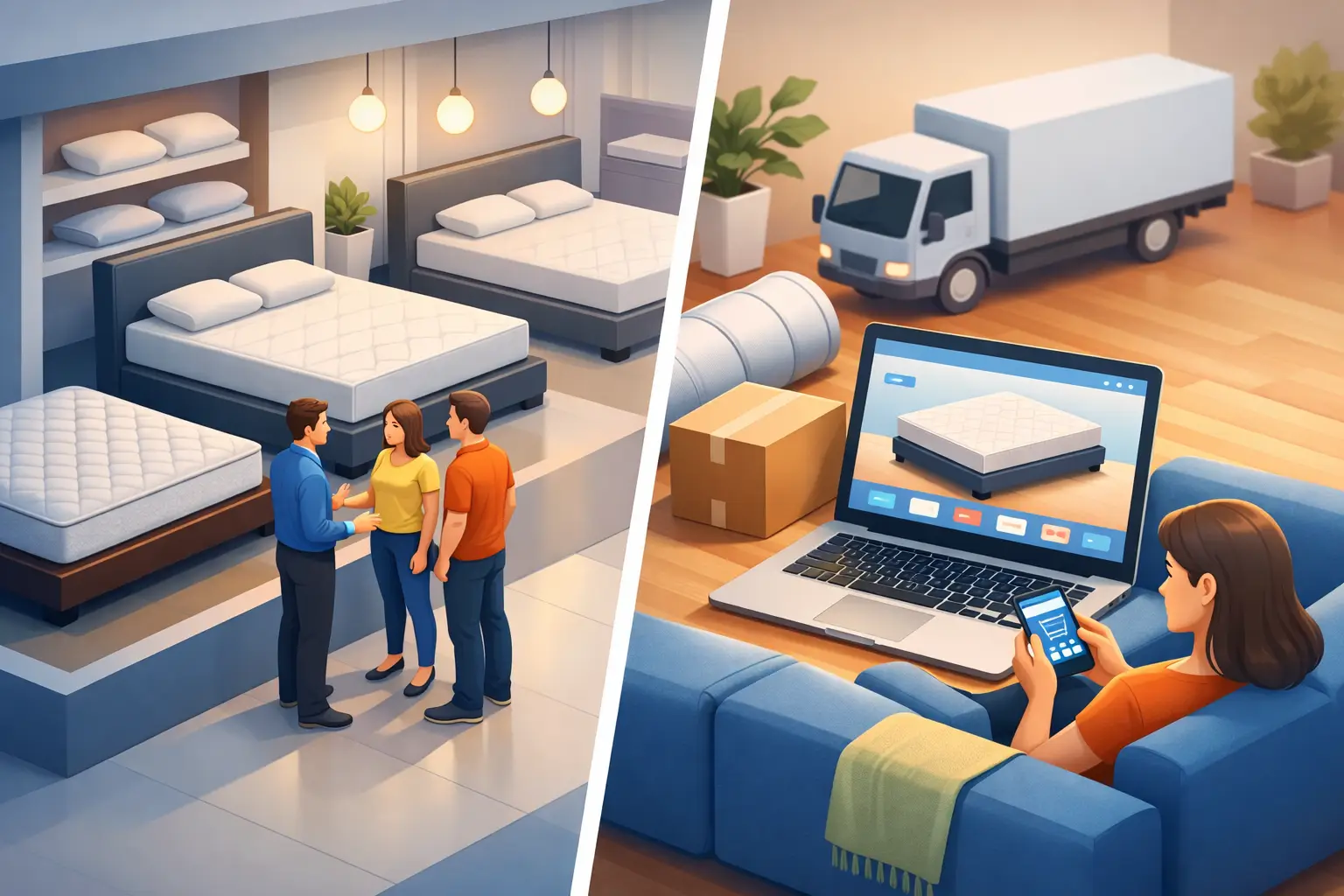
Buying a mattress usually gets real the moment two people disagree about comfort. One wants a firmer feel for back support. The other wants pressure relief and a softer surface. That is where mattress showroom vs online buying stops being a simple shopping preference and becomes a decision about risk, comfort, and confidence.
For many buyers, both options can work well. The better choice depends on how certain you are about your comfort needs, how much guidance you want, and how important it is to test construction types before delivery. A mattress is not a casual purchase. It affects sleep quality, body support, and how satisfied you feel long after checkout.
The biggest difference is not just where you buy. It is how you make the decision.
In a showroom, you can lie down, compare feels side by side, and get immediate feedback from a mattress consultant. That matters when you are deciding between foam, pocket spring, Bonnell spring, latex, or memory foam options. Many customers think they know what they want until they test it. A mattress that sounds right on paper can feel completely different after ten minutes in person.
Online buying changes the process. You rely more on product descriptions, firmness guidance, construction details, warranty terms, and the retailer’s ability to narrow your choices. For shoppers who already understand what works for them, this can be efficient. If you know you prefer medium support with pressure relief, or you are replacing a mattress with a similar build, online shopping can save time without adding confusion.
A mattress showroom gives you one thing the screen cannot – physical confirmation. You can test edge support, feel how quickly the surface responds, and compare how a pocket spring mattress differs from a foam or gel memory foam design.
This matters most for buyers with specific sleep concerns. If you wake up with lower back discomfort, overheat at night, or share a bed with a partner who moves often, comfort is more technical than it first appears. In-store testing helps you notice motion transfer, pressure points, and whether a mattress feels supportive in your usual sleep position.
A showroom also reduces decision fatigue. When a broad catalog includes value, mid value, premium, and luxury categories, expert guidance keeps the selection process focused. Instead of sorting through dozens of similar listings, you can quickly eliminate the wrong fit and compare a smaller set of realistic options.
For families, this is often the most practical route. A guest room mattress, a child’s bed, and a primary bedroom mattress do not need the same construction. Consultant-led guidance helps match use case, durability needs, and comfort preferences without guesswork.
Showroom buying is strongest when feel is still uncertain. It helps when you are choosing between medium and firm support, evaluating health-focused mattress options, or shopping for more than one sleeper with different needs.
It also gives reassurance. You can ask direct questions about materials, comfort layers, support systems, mattress protector compatibility, and delivery expectations. That clarity can make the final decision easier, especially for buyers who do not want surprises after the mattress arrives.
Online buying is built for convenience, but convenience is only useful when the information is clear enough to support a good decision.
For confident shoppers, online tools are often enough. If you already know you prefer memory foam over spring, or if you are replacing a mattress with the same support profile, you may not need to test every option in person. Good online shopping lets you compare features, read construction details, review warranty information, and narrow by comfort category or mattress type without moving from store to store.
This model also works well for busy households. If your schedule makes showroom visits difficult, online buying allows you to research and decide on your own time. That is especially helpful when you are furnishing a home, upgrading multiple rooms, or replacing an older mattress quickly.
For repeat buyers, online can be even more efficient. Once you know which build suits your body and sleep habits, the process becomes less about discovery and more about confirmation.
Online shopping is at its best when you want speed, product visibility, and straightforward comparison. It allows you to review mattress categories in one place and move directly to the options that fit your needs.
It can also be easier to involve other decision-makers. A couple can review shortlisted models together, compare descriptions, and make a decision without trying to coordinate a showroom visit. For property owners or hospitality buyers, online browsing can simplify the first stage of selection before discussing volume or use requirements.
Most mattress buying decisions come down to one trade-off. Do you want to confirm comfort with your body before purchase, or are you comfortable deciding based on detailed product information and expert support?
There is no universal winner. Some sleepers are highly adaptable and can sleep well on several constructions within the same firmness range. Others are more sensitive to small differences in surface feel, support depth, or heat retention. Those buyers usually benefit more from a showroom visit.
The same applies to mattress materials. Pocket spring and Bonnell spring can both be supportive, but they do not feel the same. Memory foam and latex may both relieve pressure, but their response and bounce are different. Reading about those differences helps. Feeling them is often what settles the choice.
If your last mattress worked well and you understand why, online buying may be enough. If you know the construction, comfort level, and support profile that suits you, your risk is lower.
If you are changing mattress type, dealing with sleep discomfort, buying for a couple with different preferences, or unsure whether you need firmer support or more cushioning, a showroom is usually the safer path. The more personal or complex the need, the more valuable physical testing becomes.
This is also where guided support matters. A strong retailer should not leave you to interpret technical mattress language on your own. Whether you shop in person or online, the goal should be the same – narrowing broad choice into a confident decision based on comfort, durability, and intended use.
First-time mattress buyers often do better in a showroom because they are still learning how different constructions feel. They may start by asking for a soft mattress and then realize they actually need balanced support with a pressure-relieving top layer.
Couples benefit from either format depending on how aligned their preferences are. If both sleepers already know what they want, online shopping can be efficient. If one prefers a plush surface and the other needs stronger support, in-person comparison tends to resolve the decision faster.
Family buyers often use both. They may visit a showroom to understand the category differences, then complete later purchases online once they know which types suit each room. That blended approach is practical and often the least stressful.
Hospitality and property buyers also think differently from household shoppers. Consistency, durability, support across multiple rooms, and dependable fulfillment matter as much as surface feel. In those cases, expert consultation becomes as important as the product itself.
Whether you choose a showroom or an online store, the buying experience should reduce uncertainty, not add to it. That means clear mattress categorization, accurate descriptions, warranty coverage, and access to informed consultants who can explain the difference between product types in plain language.
This is where a retailer with both physical expertise and online support has an advantage. Towell Mattress ME, for example, brings together multiple mattress constructions and recognized brands with consultant-led guidance, which helps customers shop based on comfort and intended use rather than guesswork alone.
The strongest buying experience is not about pushing one channel over the other. It is about giving you enough clarity to choose well.
If you want the shortest path to confidence, start with the question that matters most: do you need to feel the mattress before you trust it, or do you already know enough about your comfort to buy with certainty?
