
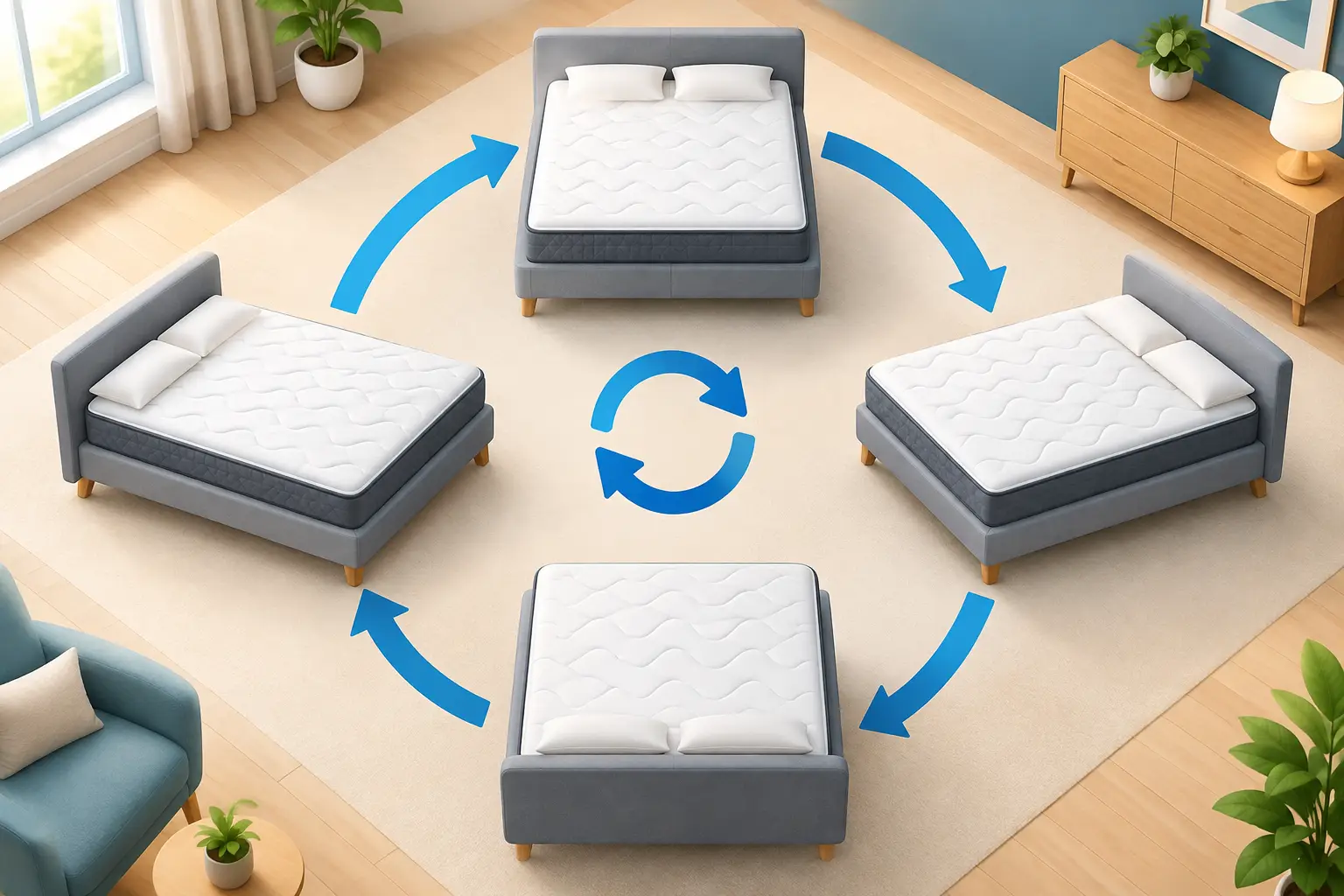
A mattress can look perfectly fine from the outside while quietly developing the body impressions that make sleep less comfortable. A consistent how to rotate mattress schedule is one of the simplest ways to spread daily wear across the surface, especially if the same person sleeps in the same spot every night.
Rotation is not a repair for a worn-out mattress, and it will not change the feel of a mattress that was never the right comfort level for you. It is, however, practical maintenance. When done at the right interval and in the right direction, it can help preserve support, extend usable comfort, and protect the investment you made in better sleep.
Rotating a mattress means turning it 180 degrees so the end that was at the headboard moves to the foot of the bed. You are not turning it over. The sleep surface remains facing up.
This distinction matters because most modern mattresses are one-sided. Pocket spring, foam, memory foam, gel memory foam, latex, and many hybrid mattresses are built with comfort layers on top and support layers underneath. Flipping a one-sided mattress can put you on the wrong side of its construction, reducing comfort and potentially affecting performance.
Before you move anything, check the care label, warranty information, or product guide supplied with your mattress. The manufacturer’s instructions always take priority. Some designs have specific rotation guidance, while a few traditional two-sided mattresses are made to be both rotated and flipped.
For most one-sided mattresses, rotate every three to six months. The best interval depends on the mattress type, how many people use it, and whether one sleeper is significantly heavier than the other.
A simple approach is to rotate at the start of each season. This gives you four easy reminders each year and is especially useful for mattresses that receive nightly use. If that feels more frequent than your mattress needs, choose two fixed dates, such as when daylight saving time begins and ends, and rotate every six months.
| Mattress situation | Recommended rotation interval | |—|—| | New mattress during its first year | Every 3 months | | Memory foam, gel foam, or latex mattress | Every 3 to 6 months | | Pocket spring or hybrid mattress | Every 3 to 6 months | | Bonnell spring mattress | Every 3 to 6 months | | Guest-room mattress used occasionally | Every 6 to 12 months | | Two-sided mattress approved for flipping | Rotate every 3 months and flip as directed |
The first year is particularly important. New foams and fibers settle as they adapt to regular use, and early rotation helps distribute that adjustment. After the first year, you may be able to move to a six-month schedule if the mattress is wearing evenly and still feels supportive.
A three-month schedule is usually the safer choice for a mattress used by two adults every night. It also makes sense when sleepers have a noticeable difference in body weight, when a person consistently sleeps on one side of the bed, or when children regularly climb or sit in the same area.
You may also want more frequent rotation if you notice mild impressions beginning to form. Slight body conforming can be normal in certain comfort materials, particularly memory foam. The concern is a deeper, persistent dip that affects posture or makes you roll toward the center. Rotating early cannot reverse a permanent impression, but it can reduce continued pressure on the same section.
Do not rotate simply because a mattress feels uncomfortable after only a few nights. New mattresses often need an adjustment period, and comfort can also be affected by pillows, room temperature, or a base that does not provide adequate support. Give the mattress time, then assess whether the issue is settling, maintenance, or fit.
Mattresses can be awkward to handle, even when they are not especially heavy. Clear the bedside area before you begin, remove bedding, and ask another adult to help with larger sizes. Dragging a mattress across a frame can damage its fabric or snag the cover, so lift it slightly where possible.
Stand on opposite sides of the bed, lift the mattress enough to turn it, and rotate it slowly until the foot end reaches the headboard. Make sure all corners sit evenly on the foundation or bed frame. A mattress that overhangs the base, rests on broken slats, or sits on an unsupported center area can wear unevenly regardless of how often it is rotated.
After rotation, take a moment to inspect the mattress and foundation. Look for loose stitching, stains, sagging, bowed slats, or a center support that has shifted. Catching a base problem early is often more useful than rotating more frequently.
Only flip a mattress when the product instructions say it is double-sided or flippable. A true two-sided mattress has usable comfort layers on both faces. Its care routine may alternate rotation and flipping so that every section receives more even use.
Most current mattresses should not be flipped. This includes many pillow-top, euro-top, memory foam, latex, and gel-infused models, along with most one-sided spring mattresses. Their comfort system is intentionally placed on top. Flipping can leave you sleeping on firm support components rather than the layers designed to cushion pressure points.
If you are unsure, inspect the mattress label and construction. A clearly defined quilted top, comfort layer, or pillow top is usually a sign that the mattress is designed for one-sided use. When in doubt, follow the care documentation or ask a mattress consultant before flipping it.
The best rotation schedule is the one you can remember. Add a recurring calendar reminder labeled “rotate mattress” every three or six months. You can also write the month and year on a small card kept with your warranty documents, or take a quick photo after each rotation for a simple record.
Seasonal reminders work well because they connect mattress care to other household tasks, such as washing bedding, checking protectors, or cleaning beneath the bed. This routine also gives you a chance to confirm that the mattress is centered on its base and that the protector still fits properly.
A quality mattress protector is worthwhile even when the mattress has a removable cover. It helps guard against spills, perspiration, and everyday soil that can affect hygiene and may complicate a warranty claim. Choose one that fits without pulling tightly at the corners, since excessive tension can interfere with how the mattress sits on the base.
For split king or split adjustable setups, rotate each mattress individually by 180 degrees if the manufacturer permits it and if the head and foot design allows it. Keep in mind that some adjustable-base mattresses have a designated head end because of zoning or construction. Do not assume both ends are interchangeable.
A guest-room mattress does not need the same schedule as a primary bed, but it should not be forgotten. Rotate it once or twice a year, particularly before a busy holiday or visitor season. If it has been unused for months, remove the bedding, let it air briefly, and inspect the support surface before guests arrive.
For children, rotation can help, but it is not a substitute for a supportive foundation or a mattress suited to their current needs. Children grow, and their comfort requirements can change more quickly than expected.
Rotation is preventive care, not a solution for structural failure. If you see a deep sag that remains after the mattress is unused for several hours, feel springs poking through, notice torn foam, or wake with new and persistent discomfort, inspect the warranty terms and the foundation condition.
Also pay attention to changes that happen after rotation. If one end remains dramatically softer, or the mattress has a clear valley that affects sleep position, the issue may be beyond normal settling. Continuing to rotate it may distribute use, but it will not restore lost support.
A well-maintained mattress should feel consistently supportive across the sleep surface. Set the reminder, follow the instructions for your specific construction, and treat every rotation as a quick comfort check that helps you stay ahead of uneven wear.
