
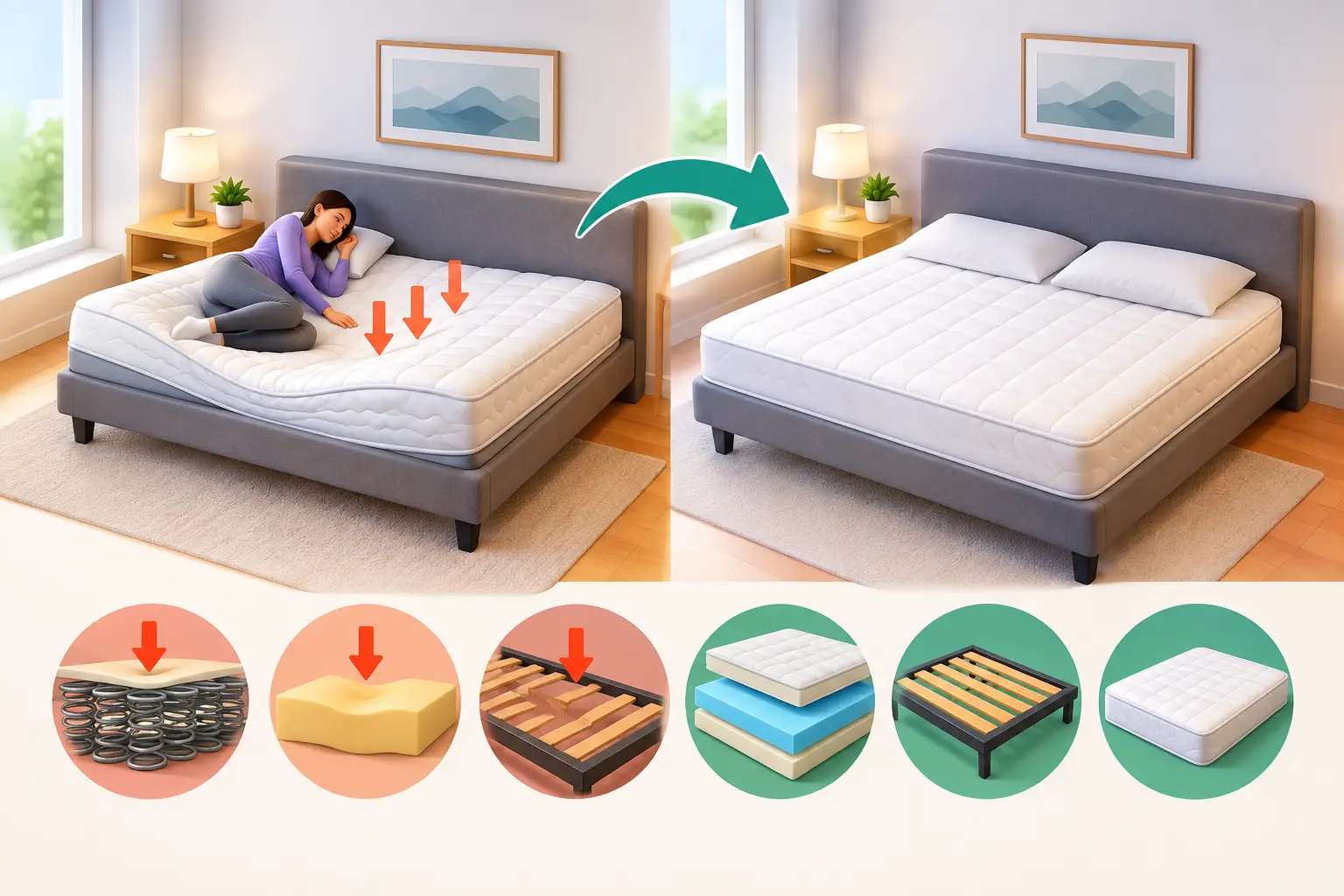
A dip in the middle of the bed can change more than how the mattress looks. It can pull your spine out of a comfortable position, make it harder to turn over, and leave you waking up with stiffness that was not there before. Understanding mattress sagging causes and fixes helps you decide whether a simple support adjustment may help or whether it is time to plan for a replacement.
A mattress is designed to distribute body weight across its surface. When the comfort layers, springs, or base beneath it stop doing that job evenly, the result is a low spot, soft edge, or visible valley. The right solution depends on where the problem started.
Not every indentation means a mattress has failed. Plush and memory foam comfort layers are meant to conform to your body, and a shallow impression may remain after you get up. This is especially common in a mattress that has been used consistently on one side.
Sagging is different. A sag usually feels like a loss of support rather than just a surface contour. You may feel as though your hips sink too far, roll toward the center, or struggle to find a level position. If the indentation remains visible without anyone lying on the mattress, check the manufacturer’s care guidance and warranty terms. Many warranties define a measurable depth for a covered body impression, often when measured without weight on the bed.
Before assuming the mattress is the issue, inspect the surface and the base separately. A sound mattress placed on an unsuitable foundation can feel like it has worn out prematurely.
A weak foundation is one of the most overlooked causes of sagging. Slats that are spaced too far apart, bowed wooden slats, a bent metal frame, or a missing center support can allow the mattress to flex where it should remain stable. Over time, that uneven flex puts extra pressure on foam layers and spring units.
For larger mattress sizes, center support is particularly important. The middle of the bed carries substantial shared weight, so a center rail with properly positioned legs helps prevent the frame from dipping. Even a high-quality mattress cannot perform as intended on a base that is not level or structurally sound.
Foam, fiber, and quilted upholstery naturally soften with use. Lower-density foams tend to lose resilience sooner, particularly in the areas that carry the most weight. Heat and repeated pressure can also make foam feel less responsive over time.
This does not mean every foam mattress will sag quickly. Construction matters. A mattress with well-matched comfort layers and a supportive core can provide consistent performance for years. However, a deep comfort system may feel softer sooner than a firmer, thinner top layer. That is a trade-off worth considering when choosing between a plush feel and a more stable sleeping surface.
In spring mattresses, the support system may eventually lose tension. Bonnell springs can wear unevenly when the same area is used night after night, while pocket springs may lose individual support in heavily loaded zones. A failing spring unit may create a soft spot, a lumpy area, or a noticeable change in support near the hips and lower back.
If you hear persistent squeaking, feel a sharp point beneath the surface, or notice that one section has become much softer than the rest, the internal spring system may be compromised. These issues usually cannot be corrected from outside the mattress.
Most people sleep in nearly the same position and area each night. Couples may create two body zones, while a single sleeper can create one concentrated impression. Over months and years, repeated pressure in the same place contributes to uneven wear.
Regular rotation can help distribute wear more evenly. It will not restore materials that have already broken down, but it can slow further deterioration when started early.
Mattresses are built for sleeping, not for concentrated impact. Sitting on the same edge every day, allowing children to jump on the bed, or placing excessive weight in one area can weaken edge support and internal materials. A mattress may still look fine at first, but recurring strain often appears later as edge collapse or localized sagging.
Moisture and poor ventilation can also affect materials. In humid conditions, allowing the mattress and its base to breathe helps maintain a cleaner, drier sleep environment. A breathable protector can guard against spills and perspiration without replacing the need for proper support underneath.
Start with the simplest checks before making a replacement decision. Remove all bedding and inspect the mattress on a flat surface. Look for visible valleys, raised areas, torn fabric, or uneven edges. Then examine the frame, slats, foundation, and center rail. Tighten loose fittings and replace any cracked, bent, or bowed components.
If your base is sound but you are unsure, temporarily place the mattress on a clean, flat floor for one or two nights. This is a diagnostic step, not a permanent setup. If the mattress feels significantly more supportive on the floor, the foundation or frame is likely contributing to the problem. If it still feels uneven, the mattress itself may be worn.
Rotate the mattress head to foot if its care label allows it. Many modern mattresses are one-sided and should not be flipped, especially pillow-top, memory foam, gel foam, and hybrid designs. Flipping a one-sided mattress can place the comfort layers underneath and make it uncomfortable. Double-sided mattresses, on the other hand, may be designed for both rotating and flipping. Always follow the instructions for your specific model.
A mattress topper can make a slightly firm mattress feel more comfortable, but it is not a true fix for structural sagging. A topper follows the shape beneath it. If the mattress has a deep valley or weak support core, adding more foam may make the sinking sensation worse. Use a topper only when the mattress remains level and supportive but needs a small comfort adjustment.
Avoid placing plywood between the mattress and base as a long-term solution. It may create a temporarily firmer feel, but it can restrict airflow, retain moisture, and fail to correct the actual source of the problem. A properly designed foundation is the better answer.
Replacement is usually the practical choice when sagging is deep, support has clearly changed, or the mattress no longer allows you to sleep comfortably. Morning back pain that improves as the day goes on, a strong rolling-toward-the-center feeling, and visible edge collapse are all signs that the bed may no longer be serving its purpose.
It is also worth considering the mattress’s age, usage, and construction. A guest-room mattress may have many years left because it has seen limited use. A main bedroom mattress used every night by two adults will experience more wear. Body weight, sleeping position, and how well the foundation has been maintained all affect lifespan, so there is no single replacement timeline that fits every household.
If a newer mattress has developed a significant indentation, document it before taking action. Photograph the surface without bedding, measure the area according to the warranty instructions, retain proof of purchase, and check whether the foundation meets the stated requirements. This makes the assessment clearer if you need service support.
The best defense against early sagging is matching construction to the sleeper and the bed base. A supportive pocket spring mattress can suit couples who want more independent movement control. High-quality foam and visco memory foam can offer close contouring, while gel-infused options may appeal to sleepers who prefer that feel with added temperature regulation. Latex is valued for its buoyant response and durability, while firmer medical or health-focused designs may suit people who need a more stable sleep surface.
There is no universally best material. A softer mattress can be comfortable for side sleepers, but it still needs enough underlying support to keep the hips from dropping too low. Back and stomach sleepers often benefit from a flatter, more stable feel. The key is to assess the full construction, including the support core, edge design, comfort layers, and compatible foundation, rather than choosing by softness alone.
A mattress consultant can help narrow the options based on sleeping position, body type, shared-bed needs, and the condition of your existing frame. At Towell Mattress ME, that guidance can help customers compare constructions with confidence instead of treating every dip in a bed as the same problem.
Your mattress should make getting into bed feel reassuring, not like settling into a hollow. Check the support beneath it, follow the care instructions, and act early when comfort begins to change. A level, well-supported sleep surface gives your body a better chance to rest the way it should.
