
You can usually tell within a few minutes whether a mattress feels right, but putting that feeling into words is harder. When customers compare memory foam vs spring mattress feel, they are often really asking a more personal question: will this mattress feel supportive, easy to move on, cool enough, and comfortable through the night?
The answer depends on how you sleep, your body type, whether you share the bed, and what kind of comfort you are used to now. Memory foam and spring mattresses can both be excellent choices, but they create comfort in very different ways. Knowing how each one feels in real use makes the decision much simpler.
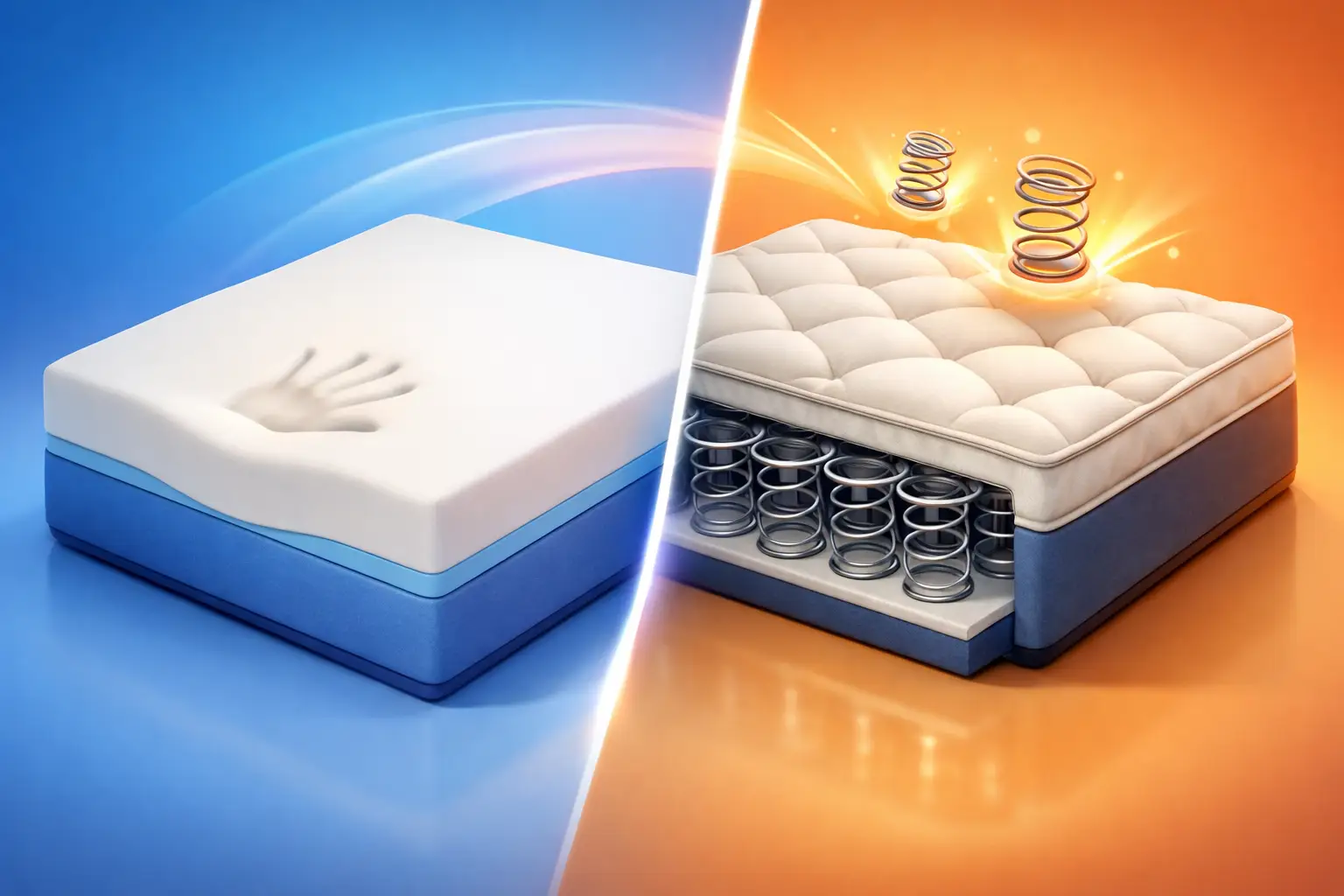
The clearest difference is how the mattress responds when you lie down. A memory foam mattress tends to contour around the body. It compresses where you apply pressure and can create a cradled, close-to-the-bed sensation. Many people describe it as a hug or a gentle molded feel.
A spring mattress feels more lifted and responsive. Instead of closely shaping itself around your body, it usually pushes back with a more traditional support feel. You sleep more on top of the mattress than in it.
That simple contrast matters more than any technical term. If you want pressure relief and a cocooning surface, memory foam often feels better. If you prefer bounce, easier movement, and a familiar hotel-style mattress feel, spring is often the better match.
Memory foam is designed to respond gradually to weight and pressure. When you lie on it, your shoulders, hips, and other heavier areas settle in more deeply than they would on many spring models. That can make the surface feel very pressure-relieving, especially for side sleepers.
This contouring is the main reason some sleepers love memory foam. It can reduce the sharp pressure points that build up when the body is not cushioned evenly. If you wake up with sore shoulders or hips, the feel of memory foam may be immediately appealing.
At the same time, that contouring can feel too close for some people. If you like a mattress that lets you change position quickly, memory foam may feel slower to respond. It is not necessarily hard to move on, but it can feel less buoyant than a spring mattress.
Temperature is another part of the feel. Traditional memory foam can retain more warmth because the material hugs the body closely. Newer builds, including gel-infused memory foam and more breathable comfort layers, can help with this, but the overall sensation is still usually less airy than a spring mattress.
A spring mattress usually feels more open, more buoyant, and more immediately supportive. As soon as you lie down, the mattress pushes back faster, so there is less of that sinking sensation associated with memory foam.
For many sleepers, this creates a cleaner, easier-to-move-on surface. Combination sleepers, who shift from side to back or stomach during the night, often notice this right away. The mattress feels quicker under the body, not slow or dense.
The exact feel depends on the spring construction. Pocket spring mattresses usually feel more refined because the coils can respond individually to different parts of the body. Bonnell spring mattresses often feel firmer, more connected across the surface, and more traditional overall.
Spring mattresses also tend to feel better ventilated. Air moves more freely through the coil system, which can help the bed feel cooler. In warm climates, that matters. A breathable sleep surface often affects comfort just as much as softness or firmness.
This is where many buying decisions are made.
Memory foam usually wins on pressure relief. It spreads body weight more evenly and cushions curves more closely. For side sleepers and people with sensitive joints, that can feel noticeably more comfortable after a full night, not just during a quick test.
Spring mattresses usually win on bounce. They feel more responsive under movement and can make it easier to get in and out of bed, turn over, or change sleeping positions. Some sleepers simply prefer that active support instead of a contouring hold.
Neither feel is automatically better. It depends on what your body responds to and what you find comfortable over several hours of sleep.
If you share a bed, feel becomes a couple issue, not just an individual one.
Memory foam usually absorbs movement better. If one person turns, gets up, or shifts during the night, the other side of the mattress is less likely to react strongly. That is why many couples like foam-based comfort layers.
Spring mattresses can transfer more motion, especially older or simpler connected-coil designs. Pocket springs generally perform better because each coil works more independently, but the bed may still feel livelier than memory foam.
For couples, the choice often comes down to what matters more: reduced partner disturbance or a more responsive, breathable surface. Some hybrid-style constructions try to balance both, but the basic feel still leans toward either contouring or bounce.
Side sleepers often prefer memory foam because it cushions the shoulders and hips more closely. That contouring can help maintain comfort in pressure-sensitive areas, especially if you stay on one side for long periods.
Back sleepers can go either way. Some enjoy memory foam because it supports the lower back with a more molded feel. Others prefer a spring mattress because it feels flatter, more lifted, and easier to move on while still offering support.
Stomach sleepers often prefer a firmer, more supportive feel that keeps the midsection from sinking too deeply. In many cases, a firmer spring mattress or a firmer foam build works better than a very plush memory foam feel.
Combination sleepers usually notice responsiveness first. If you move frequently at night, a spring mattress often feels more natural. If you move less and value pressure relief, memory foam may still be the right fit.
Body weight changes how a mattress feels.
Lighter sleepers may find memory foam especially comfortable because it provides contouring without requiring much force to compress the comfort layers. On some spring mattresses, lighter sleepers may feel that the surface is supportive but not pressure-relieving enough.
Heavier sleepers may also enjoy memory foam, but only if the build has enough underlying support. Softer foams can feel too deep or less stable if the mattress is not designed for stronger weight distribution. In that case, a well-built spring or pocket spring mattress may feel more supportive and easier to move on.
This is why mattress feel should never be judged by material alone. Construction matters. A premium spring mattress can feel more pressure-relieving than a basic foam mattress, and a well-engineered foam mattress can feel more supportive than people expect.
People often compare foam and spring when they are actually reacting to firmness. A firm memory foam mattress does not feel the same as a plush one, and a pocket spring mattress can feel very different from a firmer Bonnell model.
That is why material type should be your starting point, not your only filter. First decide whether you prefer contouring or bounce. Then look at firmness, support layers, and comfort materials.
A common mistake is assuming memory foam always means soft or spring always means firm. In practice, both can range from soft to firm. The deeper difference is in the way they respond to the body.
Choose memory foam if you want closer contouring, stronger pressure relief, and less motion transfer from a partner. It usually suits sleepers who like a cushioned, body-conforming feel and do not mind less bounce.
Choose spring if you want a more lifted sleep surface, easier movement, and a cooler, more breathable feel. It often suits sleepers who prefer traditional mattress comfort, stronger responsiveness, and a surface that feels less enveloping.
If you are unsure, the best approach is to focus on the feel you want to wake up with, not just the feel you notice in the first minute. At Towell Mattress ME, that is exactly where guided mattress selection helps most – matching construction, comfort preference, and support needs so the mattress feels right beyond the showroom test.
The best mattress is not the one with the most features. It is the one that matches your body, your sleep habits, and the kind of comfort you can trust night after night.
