
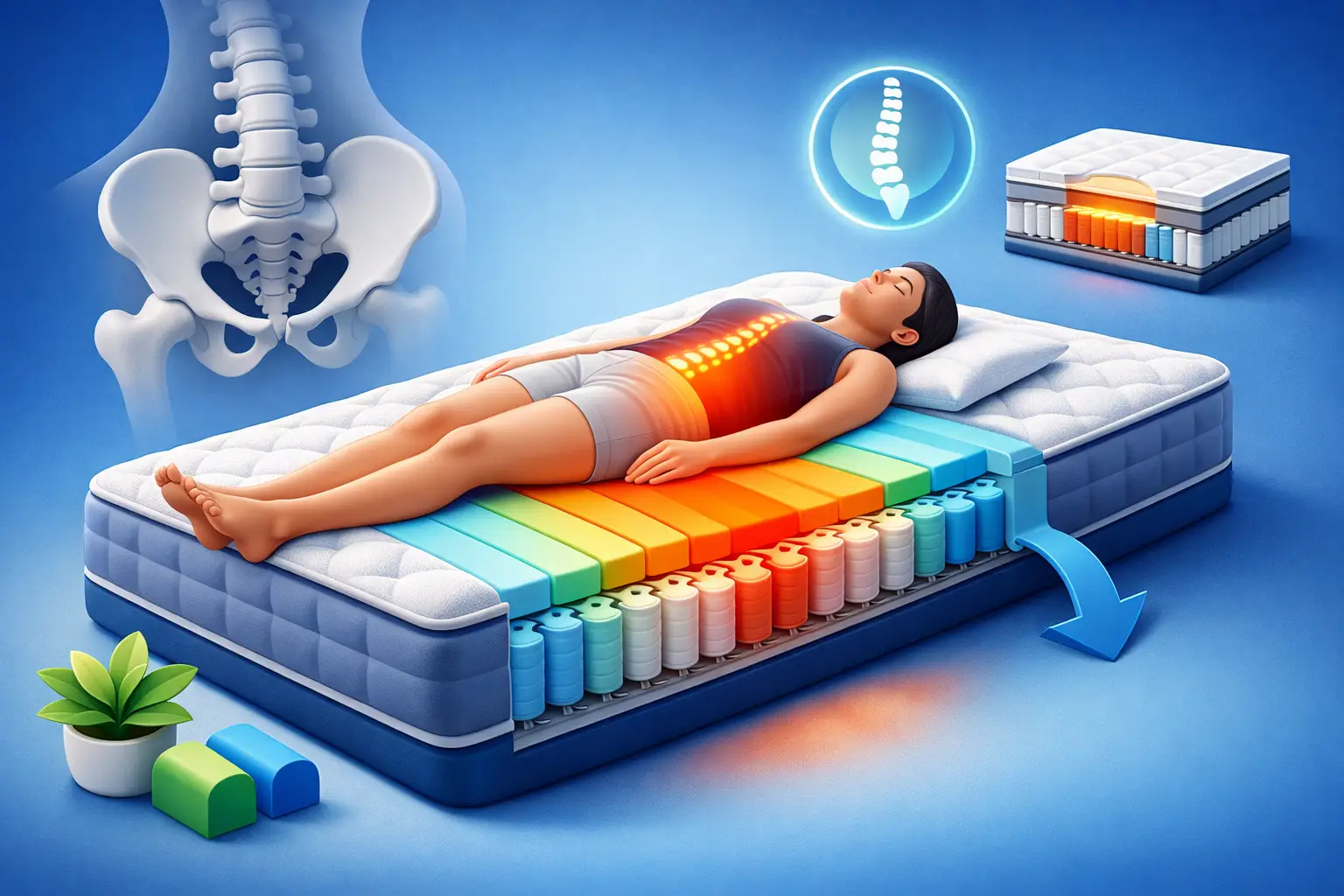
A mattress can feel comfortable for five minutes in a showroom and still leave your lower back sore by morning. That usually happens when the mattress for lower back support zone is not doing its job – keeping the heavier parts of the body supported while allowing enough cushioning at the shoulders and hips.
If you wake up stiff, feel strain across the lumbar area, or notice that your back settles only after you have been up for a while, the issue may not be “soft versus firm” alone. In many cases, it comes down to support zoning, mattress construction, and whether the surface matches your sleeping position and body weight.
A lower back support zone is a section of the mattress designed to give the middle third of the body more stability. Since the hips and lower torso carry more weight than the head or legs, this area often sinks more deeply into the mattress. When that happens, the spine can fall out of neutral alignment.
A good mattress for lower back support zone design helps reduce that dip. It supports the lumbar area and pelvis without making the bed feel hard from edge to edge. The goal is not to prop up the lower back aggressively. The goal is to keep the spine in a more even line while you sleep.
This matters whether you sleep on your back, side, or stomach, but the feel will differ. Back sleepers usually need steady lumbar support with moderate contouring. Side sleepers need zoning that still allows enough give around the shoulders and hips. Stomach sleepers often need a flatter, firmer feel through the center to avoid over-arching the lower back.
Not every support-zone mattress works the same way. The support can come from springs, foam, latex, or layered combinations.
Pocket spring mattresses are one of the most common choices for targeted lower back support. In a zoned design, the coils in the center third may be firmer or arranged to resist deeper compression. That creates stronger support under the hips and lumbar area while allowing other sections to respond more gently.
This type of construction often suits people who want a balance of contouring and pushback. It can also help limit the feeling of rolling into the middle of the bed over time, provided the build quality is strong.
Foam mattresses can create support zones by varying foam density across different sections. Higher-density foam through the center can reinforce the lower back support zone, while comfort layers above it soften the surface feel.
Memory foam adds pressure relief, which many side sleepers appreciate, but it depends on the quality and thickness of the layers. Too much sink can work against lumbar support, especially for heavier sleepers. Gel-infused memory foam may help with comfort and temperature management, but cooling features should not be confused with actual structural support.
Latex is naturally responsive, so it supports the body without the deep hug some memory foam mattresses create. For sleepers who want easier movement and stable support under the lower back, latex can be a strong option. Hybrid mattresses combine spring support with foam or latex comfort layers, and many are designed specifically to improve midsection support while keeping the surface comfortable.
Many shoppers assume the best mattress for back pain must be very firm. That is only partly true. A mattress that is too soft can let the hips sink too far, but a mattress that is too firm can create pressure and prevent the lower back from settling naturally.
What works best depends on your body type and sleeping position. A lighter-weight sleeper may get proper support from a medium mattress, while a heavier sleeper may need a medium-firm to firm feel to keep the pelvis from dipping. Side sleepers usually need more cushioning than back or stomach sleepers, even when lower back support is a priority.
This is why consultant-led guidance matters. Two mattresses can both be labeled medium-firm, yet feel very different because of their construction. Support comes from the core and transition layers, not just the word on the product tag.
A poor lower back support zone tends to show up in predictable ways. Morning stiffness that improves after stretching is one common sign. Another is feeling your hips sink lower than the rest of your body when lying down.
You may also notice that your mattress feels comfortable at first but becomes tiring after a full night’s sleep. In some cases, the issue is age-related wear rather than the original design. Foams soften, springs lose consistency, and the center of the mattress often shows fatigue first because it carries the most load.
If you sleep with a partner, the problem can be more noticeable when the mattress lacks enough central support for two different body weights. One sleeper may feel fine while the other develops lower back discomfort because the support response is uneven.
Start with sleeping position. Back sleepers usually do well with a mattress that holds the lumbar area up while still cushioning the shoulders and hips. Side sleepers should look for support zoning that prevents sagging through the middle but does not create pressure points. Stomach sleepers often need firmer center support to keep the pelvis level.
Next, consider body weight. This affects how deeply you compress the comfort and support layers. Heavier sleepers often benefit from stronger coil systems, denser foams, or more resilient latex. Lighter sleepers may find a very firm zoned mattress uncomfortable because they do not compress it enough to get proper contouring.
Then look at mattress type. Pocket spring and hybrid models are often strong choices for customers who want both support and airflow. Memory foam can work well if the support core is substantial and the top layers are not too soft. Latex suits those who prefer a more responsive feel with steady support.
Durability should also be part of the decision. Lower back support is not just about how a mattress feels on day one. It is about whether that center-zone support holds up with regular use. Quality materials, a proper warranty, and guidance from experienced mattress consultants can make the choice more reliable.
One of the biggest mistakes is choosing by softness alone. A plush feel can be appealing in the first few minutes, but if the support layers underneath are weak, the lower back may not stay aligned overnight.
Another mistake is focusing only on the word “orthopedic” or “medical” without looking at what is inside the mattress. Those labels can be helpful, but construction still matters. You want to know whether the mattress uses zoned springs, high-density support foam, latex, or another method to reinforce the lumbar area.
It is also common to overlook pillow height. Even a strong mattress for lower back support zone can feel wrong if the pillow pushes the neck too high or lets it drop too low. Spinal alignment works as a system.
Not everyone needs a pronounced lower back support zone, but many people benefit from it. Adults with recurring lumbar stiffness often do. So do sleepers who carry more weight through the hips and midsection, and couples who need a mattress that stays stable across the center.
For guest rooms, family homes, and hospitality settings, zoned support can also be a practical choice because it suits a wider range of body types than a very soft or very rigid mattress. It helps create a more balanced sleep surface for different users.
Towell Mattress ME focuses on this kind of guided selection for a reason. Lower back comfort is highly personal, and the right fit usually comes from matching mattress construction, comfort preference, and support needs rather than choosing by label alone.
When lying on a mattress with a proper lower back support zone, you should feel supported through the center without feeling pushed upward. Your hips should not drop sharply below the rest of your body. If you sleep on your side, your shoulders and hips should still have enough room to settle in naturally.
Give it a few minutes in your normal sleep position. Pay attention to whether your lower back feels held in a neutral way or whether you start noticing strain. The best choice usually feels stable, not stiff, and comfortable, not overly cushioned.
The right mattress should make your body feel level and settled. If your lower back has been asking for better support, that is the standard worth shopping for.
