
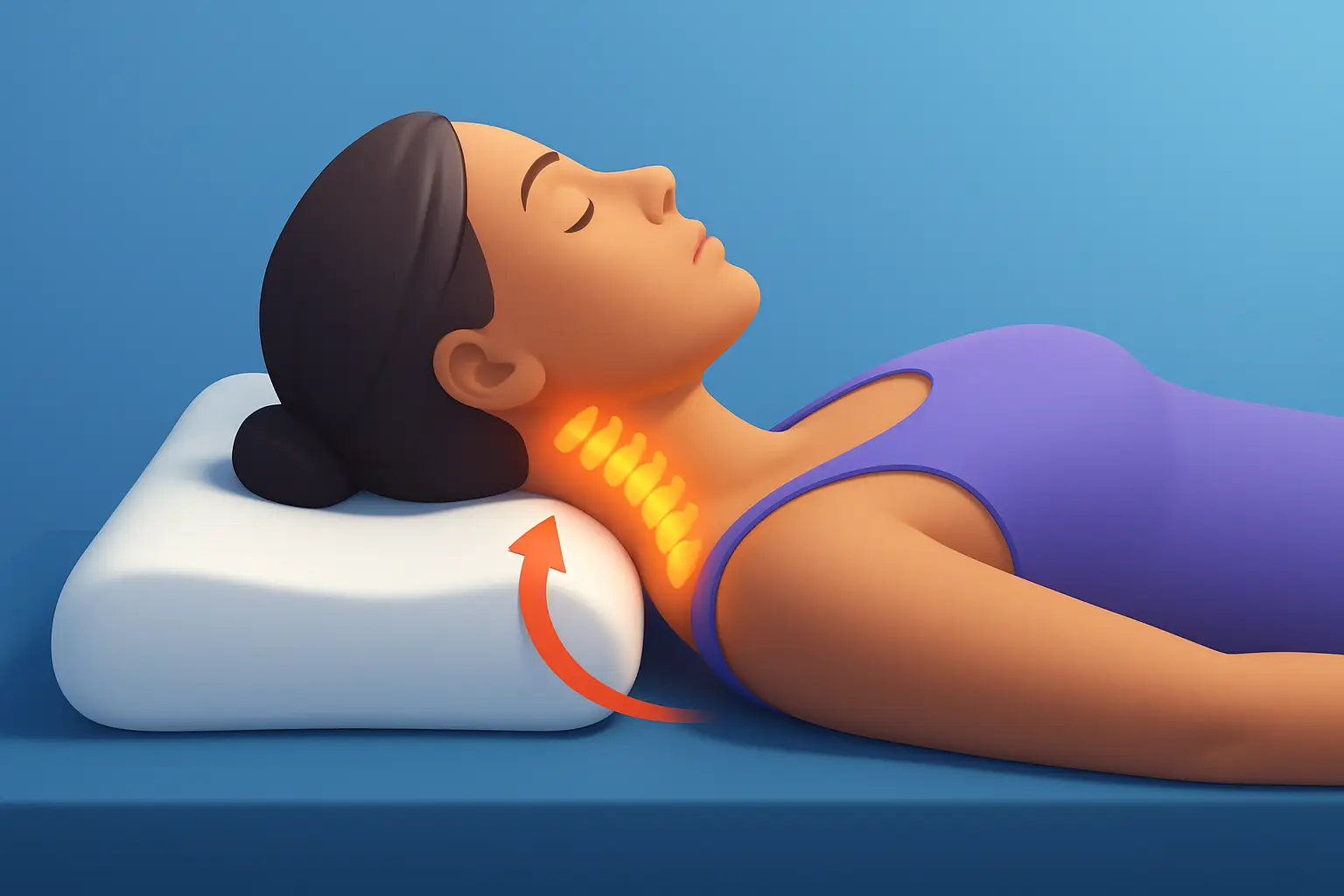
You can feel it the moment a pillow is wrong – your chin tips up, your head falls back, or your neck has to “hold” your skull all night. Then you wake up stiff, not because you slept “weird,” but because your pillow kept your spine in a position it can’t relax into.
If you’re trying to choose pillow for neck pain alignment, start with one clear goal: when you’re lying down, your neck should feel supported and neutral, like it’s simply continuing the line of your upper back. A pillow is not supposed to be soft decoration. It is a positioning tool.
Neck alignment is simple in concept and surprisingly specific in practice. In a neutral position, your head is neither tilted toward the ceiling nor dropped toward your chest, and it’s not leaning to one side. Your muscles can stand down because the pillow is carrying the load.
The tricky part is that “neutral” depends on your sleep position, your shoulder width, and the firmness of your mattress. A pillow that feels perfect in a showroom can fail at home because your mattress allows your shoulder and ribs to sink more (or less) than you expected.
A quick self-check helps: when you lie in your usual position, you should be able to breathe easily, swallow comfortably, and relax your jaw. If you feel like you need to tuck your chin, push the pillow away, or stack your arm under your head, the pillow is not matching your alignment needs.
When customers come in asking for “a pillow for neck pain,” what they often need is clarity on three variables: loft (height), support (how well it holds shape under weight), and shape (standard vs contoured).
Loft sets the distance your head must be lifted to stay level with your upper spine. Support determines whether the pillow keeps that loft through the night or collapses after 20 minutes. Shape decides where the support is delivered – evenly across the pillow, or concentrated under the neck.
Material matters because it influences support and temperature, but the material is rarely the first decision. You can buy memory foam, latex, gel-infused foam, or fiber fill and still get neck pain if the loft and support don’t match your body.
Sleep position is the fastest way to narrow the right loft range.
Side sleeping creates the biggest gap between your head and the mattress, especially if you have broader shoulders. You generally need a higher loft and reliable support so your head doesn’t tilt down toward the bed.
The most common side-sleeper mistake is choosing a pillow that feels plush but compresses too much. It may feel “soft,” but it forces your neck to bend sideways for hours. If you wake up with pain on one side of the neck or a tight upper trap, you may be under-supported.
A second mistake is going too high. If your pillow pushes your head up, you’ll feel pressure near the jaw and ear, and you may wake with headaches. The right pillow keeps your nose aligned with the center of your chest, not angled down or up.
Back sleepers typically do best with a medium loft that supports the natural curve in the neck. If the pillow is too high, your chin gets pushed toward your chest, which can lead to morning stiffness and a “tight front of neck” feeling.
If it’s too low, your head can fall back, and the neck muscles may stay engaged to stabilize. Many back sleepers do well with a pillow that has some contour or a slightly firmer core that resists flattening, so the neck doesn’t lose support as the pillow warms up.
Stomach sleeping is hard on the neck because it usually requires turning the head to the side. If you can’t change positions, the best pillow strategy is minimal loft and high softness so you’re not adding extra extension to the neck.
Here’s the honest trade-off: even the “right” pillow won’t fully neutralize stomach sleeping. If neck pain is ongoing, retraining toward side or back sleep often matters more than any material upgrade.
A pillow doesn’t work alone. The mattress changes how far your shoulder and upper back sink, which changes the effective loft you need.
On a softer mattress, your shoulder sinks more, so you usually need less pillow loft than you would on a firm mattress. On a firmer mattress, you may need a higher loft to keep your head level.
This is why buying a pillow without considering your mattress can be frustrating. Two people can be the same height and sleep position and still need different pillows because their mattresses behave differently.
Material is about feel, temperature, and how consistently the pillow holds you in place.
Memory foam is popular for neck pain because it molds around the head and neck and can provide stable support, especially in a contoured shape. The downside is heat retention for some sleepers and the “slow response” feel if you change positions often.
Latex tends to feel more buoyant and responsive. It supports without the deep sink of memory foam and often sleeps cooler. People who dislike the stuck-in feeling of memory foam frequently prefer latex.
Gel-infused foams aim to reduce heat buildup while keeping the supportive feel of foam. Results vary by product, but the key is still whether the foam density supports your neck through the night.
Fiber fill and down-alternative pillows can be comfortable and budget-friendly, and they’re easy to adjust by scrunching. The risk is compression and lumping. If you choose fiber fill for neck pain, look for higher-quality fill that resists flattening, and expect to replace it sooner than foam or latex.
A standard pillow can work perfectly if the loft and support match your body. Contoured pillows are most helpful when you need targeted neck support, especially for back sleepers and some side sleepers who struggle to keep the neck curve supported.
Contoured designs can also be unforgiving. If the contour height is wrong for your neck length and shoulder width, you’ll feel pushed into an awkward posture quickly. They’re not automatically “better,” but they can be very effective when fit is correct.
If you’re between sizes, it’s usually safer to prioritize correct loft in a standard shape than to gamble on a contour that may not match your anatomy.
You don’t need a lab to evaluate pillow alignment. You need a mirror, a phone camera, or a second person.
First, do the side-view test. Lie in your normal position and have someone take a photo from behind you at mattress level. For side sleeping, your neck should look straight, not angled down toward the bed and not arched up. For back sleeping, your chin should be neutral, not tucked.
Second, do the pressure and compensation test. If you keep moving the pillow, stacking an arm under your head, or waking up and re-fluffing repeatedly, your pillow is not stable enough for your alignment needs.
A good pillow can reduce neck strain quickly, but it isn’t the only factor. If your mattress is too soft and your upper body sinks unevenly, a pillow can’t fully correct the angle at your neck. If your mattress is too firm and creates pressure points at the shoulder, you may also tense up and blame the pillow.
Also consider timing. If pain is worst first thing in the morning and improves as you move, that often points to sleep posture and support. If pain is constant all day, radiates down the arm, includes numbness or tingling, or worsens rapidly, it’s worth speaking with a clinician.
If you want to choose pillow for neck pain alignment without getting buried in options, narrow it in this order: sleep position first, then loft range, then material feel and temperature, then shape. Try to evaluate the pillow the way you actually sleep, on a surface similar to your mattress firmness.
If you want a guided match across pillow types and comfort tiers – value through premium – a consultant-led retailer can help you avoid the common mistake of buying based on softness alone. This is the same approach we use when helping customers compare foam, latex, and specialty pillows alongside mattress choices at Towell Mattress ME.
The goal is simple: you should lie down and feel like your head has a home and your neck can stop working.
A helpful closing thought: if your pillow feels “comfortable” but you still wake up sore, trust the morning feedback. Comfort is immediate. Alignment is what you feel after six to eight hours.
